
Nueva Andalucía Guide
Marbella’s Golf Valley
What is Nueva Andalucía?
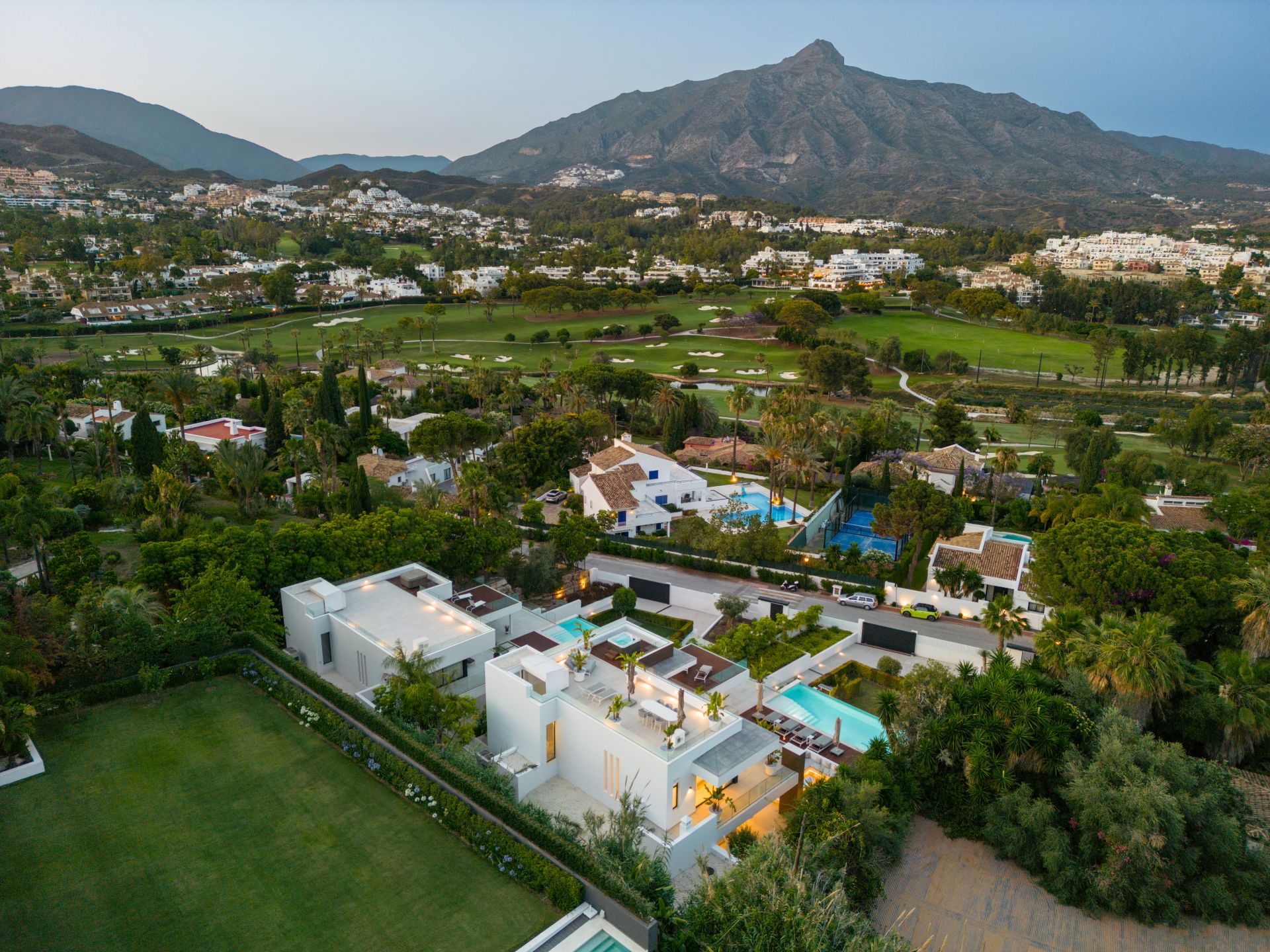
Nueva Andalucía is Marbella’s largest residential district, an inland valley built around five golf courses and known locally as the “Golf Valley.” It sits between Marbella town and San Pedro de Alcántara, just inland of Puerto Banús, and is not a separate municipality but an official district within Marbella. Where the name can get confusing is at the edges: some agents use “Nueva Andalucía” loosely to include areas like Aloha, La Cerquilla and Las Brisas, which are technically named sub-communities within the district. This guide treats Nueva Andalucía as the whole Golf Valley and names each sub-area individually below.
Unlike Marbella’s beachfront addresses, Nueva Andalucía was planned from the outset as a residential and sporting district rather than a resort strip — its identity was built around golf, gardens and low-rise villa living rather than promenade and marina life. That original planning logic is still legible today: wide, low-traffic roads, generous plot sizes, and a layout organised around clubhouses rather than a seafront.
History of Nueva Andalucía
Nueva Andalucía was developed from the 1960s onward by Madrid-born property developer José Banús, the same man behind the marina that carries his name. Banús acquired a large estate in the valley — previously used for breeding fighting bulls — with the ambition of building an upscale residential district alongside a new marina on the coast below it. Construction of Puerto Banús began in 1965 and the marina opened in 1968; the roads, villas and first golf courses of Nueva Andalucía followed shortly after.
The area’s architectural character owes a debt to Prince Alfonso Hohenlohe, the aristocrat credited with putting Marbella on the map through the Marbella Club Hotel. In 1966 he introduced Banús to Marcos Sainz and Noldi Schreck, two architects who had worked on residential developments in Beverly Hills and had already shaped the Mediterranean style of the Marbella Club. Their influence is still visible in Nueva Andalucía’s low-rise, garden-set villa communities.
Golf came early and became the area’s defining feature: Real Club de Golf Las Brisas opened in 1968, followed by Los Naranjos in 1977 and Aloha Golf Club soon after. The district expanded steadily through the 1980s and again in the 2000s, and today Nueva Andalucía is the largest neighbourhood in Marbella by area.
Where is Nueva Andalucía?
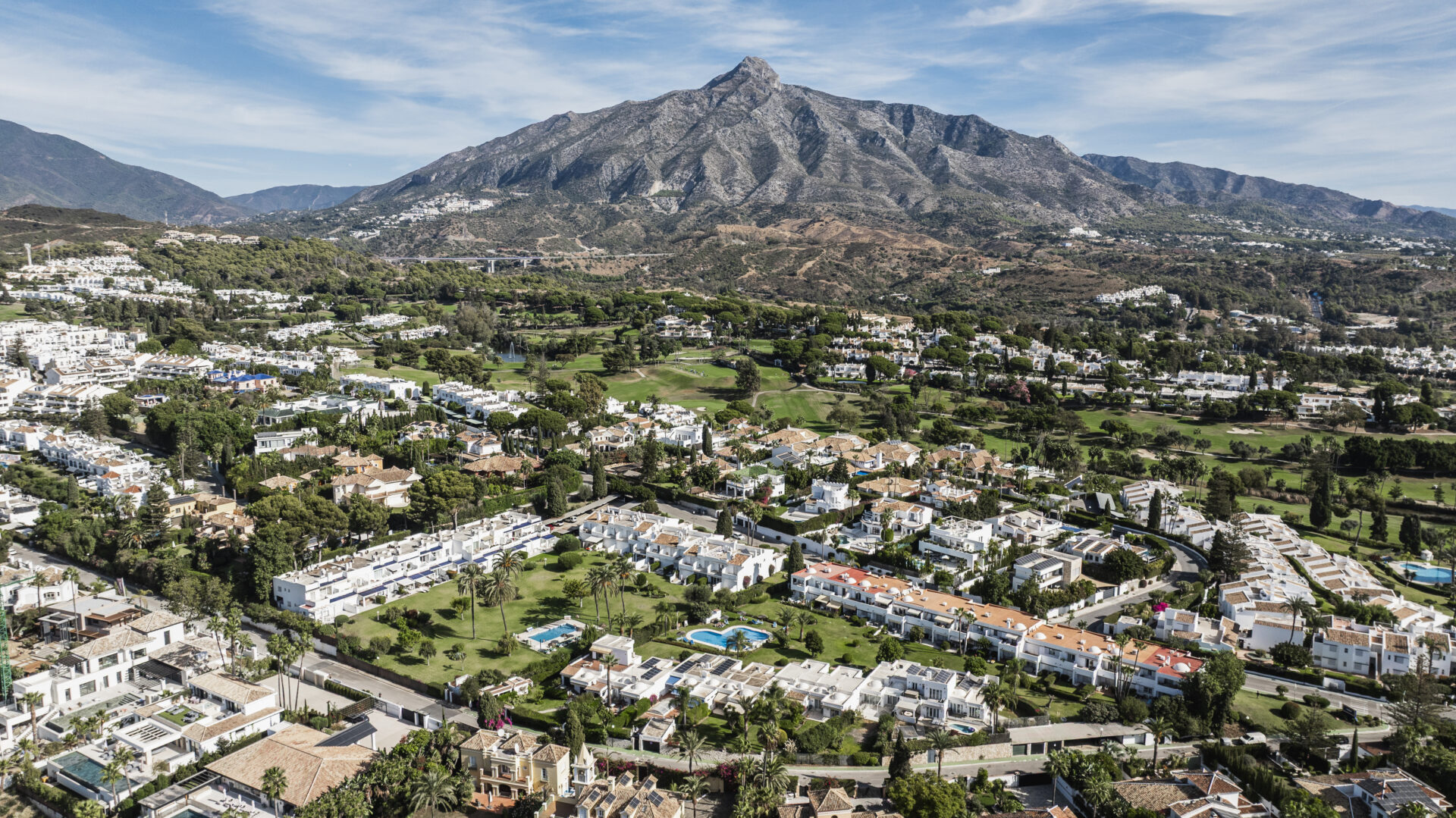
Nueva Andalucía sits inland of Puerto Banús, in the foothills of La Concha mountain, roughly midway between Marbella town centre and San Pedro de Alcántara. It has direct access to the AP-7 toll motorway and the parallel A-7 coast road, both of which run along its southern edge.
The district occupies a shallow valley rising gently from the coast road up into the foothills, which is why elevation — rather than proximity to the beach — is the main factor separating one sector from another. Lower-lying areas near Centro Plaza and Los Naranjos sit closest to the coast road and Puerto Banús; the higher sectors, La Cerquilla and La Quinta, sit further back against the mountain and take longer to reach the beach but gain openness, quiet and, in places, a sea view over the rooftops below.
| Destination | Distance | Drive Time |
| Puerto Banús | ≈4 km | ≈5 min |
| Marbella Centre | ≈7 km | ≈10 min |
| San Pedro de Alcántara | ≈5 km | ≈8 min |
| Málaga Airport (AGP) | ≈56–58 km | ≈38–45 min |
| Gibraltar Airport (GIB) | ≈65 km | ≈55–60 min (plus border time) |
How big is Nueva Andalucía and how many people live here?
Nueva Andalucía covers roughly 8.7–10 km², making it the largest district in Marbella by land area. Population figures vary by source and season: the official registered census puts the district at around 15,000 residents, while other counts (including seasonal residents) put the figure closer to 18,500. What’s consistent across sources is that a large majority of residents are foreign nationals, reflecting the area’s long-standing pull for international buyers and long-term expats rather than short-stay tourists.
| Sub-area | Character |
|---|---|
| La Cerquilla | The most elevated sector, in the north of the district. Golf-frontline villas and townhouses close to Los Naranjos, Aloha and Las Brisas, with some of the few positions in Nueva Andalucía that catch genuine sea views. |
| Aloha | The oldest and most established residential zone, built around Aloha Golf Club. Large villas, mature gardens, and the small Aloha Pueblo village centre with shops and cafés. |
| Los Naranjos | A mixed area of villas and mid-rise apartment complexes with direct access to Los Naranjos Golf Club, one of the district’s more accessibly priced sectors. |
| Las Brisas | Named after the prestigious Real Club de Golf Las Brisas. Established villa community with mature plots and one of Marbella’s most desirable golf-front locations. |
| Nueva Andalucía Centre (La Campana / Centro Plaza) | The district’s everyday hub, offering restaurants, supermarkets, banks and services clustered around La Campana and the Centro Plaza shopping complex. |
Browse current listings across the district on our Nueva Andalucía properties page.
What style of homes can you find in Nueva Andalucía?
Nueva Andalucía offers one of the broadest property mixes in Marbella, from classic 1970s and ’80s Andalusian-style villas with whitewashed walls and terracotta roofs, through to contemporary new-build villas and boutique gated apartment complexes finished in the last five years. Golf-frontline plots in La Cerquilla, Las Brisas and Aloha tend to carry the largest villas, often 500–1,000+ m² of build on generous plots, while Los Naranjos and the Centre area have a denser mix of townhouses and mid-rise apartment buildings aimed at both permanent residents and second-home buyers. Several established villa communities are now going through renovation or full rebuilds, replacing dated 1980s design with clean-lined contemporary architecture while keeping the same mature, established gardens. Explore current new-build options on our New Developments page.
What style of homes can you find in Nueva Andalucía?
| Segment | Avg. asking price / m² | Typical starting price |
|---|---|---|
| All property types (district average) | ≈€6,300/m² | from ≈€400,000 |
| Villas | Premium to district average, higher on golf-frontline and elevated plots | from ≈€1.5M, rising well beyond €10M on La Cerquilla/Aloha frontline plots |
| Apartments & townhouses | At or below district average, depending on sector | from ≈€400,000 |
Nueva Andalucía has been one of Marbella’s stronger-performing markets, with asking prices up roughly 18–19% year-on-year as of mid-2026, driven by an international buyer base — predominantly from the UK, Scandinavia and the Benelux countries — competing for a limited supply of gated villas and modern golf-view apartments.
What is there to do in Nueva Andalucía?
Dining
Nueva Andalucía’s dining scene has outgrown its old reputation as a golfers’ pit-stop between rounds. The headline arrival is Brasserie Astoria, which opened in May 2025 on Avenida del Prado: a 234-cover grand brasserie from the Frantzén Group, led by Michelin-starred Swedish chef Björn Frantzén, built around flambé trolleys, tableside service and a 19th-century dining-hall style — one of the most significant restaurant openings on the Costa del Sol in recent years.
Below that tier, the streets around La Campana hold a dense, mostly independent dining scene: Restaurante La Campana for classic, family-style Spanish and Italian dishes, and Sisters Restaurant for Mediterranean home cooking in the same pocket of streets. At Centro Plaza, Starz Café is the daytime social hub — coffee, brunch and people-watching rather than a destination dinner. For lunch or dinner after a round, the clubhouse restaurants at Real Club de Golf Las Brisas and Aloha Golf Club are reliable, view-led options overlooking the fairways.
Beyond the headline openings, the district’s everyday dining scene runs deep: Alba Marbella serves an elegant Italian menu just off Avenida del Prado, VOven has built a following among steak specialists for its Repsol-recognised selection of a dozen or more breeds, and Tomodachi’s izakaya-style Japanese menu draws a loyal following at a lower price point than the equivalent on the Golden Mile. For a quick coffee or brunch at Centro Plaza, Brödernas and Cafe Yanx are the district’s everyday cafés.
Golf, tennis and outdoor sport
Golf is the reason Nueva Andalucía exists as a district, and it shows: five courses sit within its boundaries, including Real Club de Golf Las Brisas (1968), Los Naranjos Golf Club (1977), Aloha Golf Club, La Quinta Golf & Country Club, and Magna Marbella Golf Club. Las Brisas and Los Naranjos were both designed by Robert Trent Jones Sr., while Aloha was laid out by Spanish architect Javier Arana — three distinct styles of course within a few minutes’ drive of each other.
Beyond golf, Aloha Tennis & Padel Club, opened in 2019, offers seven clay tennis courts and two padel courts alongside a gym and spa area, with coaching programmes built on methods used to train Rafael Nadal. The surrounding foothills of La Concha mountain offer walking and hiking routes a short drive away.
Magna Marbella Golf Club rounds out the district’s five courses with a further 18-hole option, while padel — Spain’s fastest-growing sport — is well served at Aloha Tennis & Padel Club alongside golf lessons for juniors and adults alike.
Shopping
Centro Plaza is the practical hub — supermarkets, pharmacies, banks and a post office all within one complex — supplemented by a weekly street market selling antiques, crafts, local produce and leather goods. It’s a working local centre rather than a tourist retail strip, which suits the district’s year-round resident base; for larger-format and fashion retail, La Cañada shopping and cinema complex is roughly a 20-minute drive east, on the far side of Marbella centre.
For a fuller retail trip, La Cañada — one of the Costa del Sol’s largest shopping and cinema complexes — is a 20-minute drive east, while Puerto Banús‘s marina, five minutes south, adds designer boutiques from Gucci, Louis Vuitton and Dior for residents who want a change of scene.
Nightlife and wellness
Casino Marbella, one of only two casinos on the Costa del Sol, operates in Nueva Andalucía with regular live entertainment, slot machines and table games. Aloha Tennis & Padel Club’s spa and gym cover everyday wellness within the district. For a fuller night out — late bars, beach clubs, a wider spread of restaurants — Puerto Banús is five minutes away.
For a livelier night out, Puerto Banús‘s marina clubs — including TIBU and the recently reopened Ocean Club — are five minutes away and stay busy well past midnight through the summer season.
Compare lifestyle options across Marbella’s other districts in our full collection of area guides, including the Golden Mile and San Pedro de Alcántara.
Compare lifestyle options across Marbella’s other districts in our full collection of area guides, including the Golden Mile and San Pedro de Alcántara.
What is life like for kids in Nueva Andalucía?
Family-friendly is the district’s defining reputation. Many of the gated villa and townhouse communities have their own gardens, pools and play areas, and the presence of Aloha College inside the district means many families choose Nueva Andalucía specifically to be within a short drive — sometimes walking distance — of their children’s school. Aloha Sports Club adds tennis, padel and swimming facilities used by local families outside school hours, and the low-rise, low-traffic layout of most residential sectors makes the area notably walkable and safe for children compared with busier parts of central Marbella.
Because such a large share of residents are long-term international families rather than short-stay holidaymakers, the district also has an established rhythm of school runs, weekend club sport and children’s parties that newer arrivals tend to fold into quickly — something families moving from Puerto Banús or the Golden Mile often cite as the main lifestyle shift when they relocate to Nueva Andalucía.
Schools near Nueva Andalucía
| School | Age range | Distance / location |
|---|---|---|
| Aloha College | Age 3–18 (IB and A-Levels) | Located inside Nueva Andalucía; walking distance to a short drive for most of the district’s residential sectors. |
| Svenska Skolan Marbella (Swedish School) | Age 3–16 (Swedish curriculum) | Located in La Alzambra, Nueva Andalucía, close to Puerto Banús; within walking distance or a short drive for most residents. |
| Swans International School (Primary) | Early years–Primary | El Capricho campus, central Marbella; short drive from Nueva Andalucía. |
| Swans International School (Secondary) | Secondary | Sierra Blanca campus, Marbella Golden Mile; short drive from Nueva Andalucía. |
Aloha College, founded in 1982, now teaches over 900 students from around 57 nationalities and offers a choice of the International Baccalaureate or A-Levels — it was one of the first schools on the Costa del Sol to introduce the IB. For a fuller comparison of coastal schools, see CarlingPetri’s Buyer’s Guide.
Nueva Andalucía vs. Puerto Banús and the Golden Mile — what’s the difference?
The three areas sit within a few minutes of each other but serve different buyers. Puerto Banús and the Golden Mile are beachfront, walkable to restaurants and nightlife, and carry a higher share of foreign ownership — both areas report over 50% foreign-owned property, against roughly 40% in Nueva Andalucía. Nueva Andalucía trades beach proximity for space: larger plots, golf-frontline living, and a more residential, family-driven daily rhythm rather than an evening-social one. Buyers prioritising a beachfront address and marina lifestyle tend to look at Puerto Banús or the Golden Mile first; buyers prioritising space, golf and schools tend to choose Nueva Andalucía. Families weighing the two areas against each other, or against San Pedro de Alcántara a little further west, often end up comparing all three before deciding — worth reading alongside this guide if you’re not yet set on a specific district.
Fun facts about Nueva Andalucía
- Nueva Andalucía was developed by José Banús, the same Madrid developer behind Puerto Banús marina, which opened in 1968.
- The land now covered by golf courses and villas was previously a working estate used for breeding fighting bulls.
- Real Club de Golf Las Brisas, opened in 1968, was one of the first golf courses built in the district and remains one of the most prestigious on the Costa del Sol.
- Architects Marcos Sainz and Noldi Schreck, introduced to developer José Banús by Prince Alfonso Hohenlohe in 1966, helped shape the area’s low-rise Mediterranean residential style — the same architects who had earlier worked on developments in Beverly Hills.
- Aloha College, inside the district, was founded in 1982 and now teaches over 900 students from around 57 nationalities — it was one of the first schools on the Costa del Sol to offer the International Baccalaureate.
- Sir Sean Connery, a Marbella resident through the 1970s to mid-1990s, was a regular player on the district’s golf courses, including Las Brisas and Aloha.
Frequently Asked Questions
Is Nueva Andalucía part of Marbella?
Does Nueva Andalucía have sea views?
What is the average property price in Nueva Andalucía?
Is Nueva Andalucía good for families?
How far is Nueva Andalucía from Puerto Banús and the airport?
What’s the difference between Nueva Andalucía and the Golden Mile?
How many golf courses are in Nueva Andalucía?
Buying in Nueva Andalucía with CarlingPetri
CarlingPetri’s Marbella team works across every sector of Nueva Andalucía, from golf-frontline villas in La Cerquilla and Aloha to modern apartments around Los Naranjos and the Centre. Björn Gustafsson Carling, our named Nueva Andalucía specialist, can talk you through current inventory, realistic pricing by sector, and which communities suit your priorities — schools, sea views, or golf access. Start with our Nueva Andalucía listings, get a clear view of costs in our Buyer’s Guide, or explore financing options before you view. For more on daily life in the area, see our Nueva Andalucía lifestyle articles.
Buy with us
Tell us how you want to live, and we find the property to match. You’ll get homes that fit your needs, learn what each area is really like, and get full support throughout the entire process. Our buyers come from the UK, Scandinavia and across Europe, and we look after each of them in their own language.